





TERMS OF REFERENCE
CONSULTANCY TO DEVELOP AND DELIVER TRAININGS
ON RESTORATIVE JUSTICE WITH CHILDREN IN CONTACT WITH THE LAW
i-RESTORE 2.0 – Curriculum developer/trainer for face-to-face courses on Restorative Justice with Children in Contact with the Law
Term of Reference
Location: Greece
Title: i-RESTORE 2.0 – Curriculum dev
eloper/trainer for face-to-face courses on Restorative Justice with Children in Contact with the Law
Period of the consultancy: 02 May – 20 December 2023
Duration of the consultancy: 17 working days
1. Presentation of Terre des hommes
Terre des hommes (Tdh), founded in 1960, is an independent, neutral and impartial Swiss organisation committed to bringing meaningful and lasting change to the lives of children and youth, especially to those mostexposed to risks. We strive to improve their well-being and ensure the effective application of their rights as defined by the Convention on the Rights of the Child and other relevant human rights instruments.
Since 1996, Tdh has been working on juvenile justice in numerous countries across the globe. In 2020, 93,400 children, young people and members of their communities were supported in access to justice.
Built on years of experience and capitalization of best practices, Tdh’s actions are based on a child-friendly approach to justice, which means that justice is adapted to children, to their maturity and level of development, and on a restorative approach, which seeks to repair the damage caused to the individuals, the affected parties and the wider society, and which requires active participation of the child offender, the victim and other involved members to resolve the conflict.
Our work in the field of Access to Justice:
Tdh’s work in Access to Justice contributes directly to Sustainable Development Goal N°16, namely 16.2 reducing violence against children and 16.3 reinforcing access to justice. It also endeavors to protect the rights of children in conflict with the law (articles 37 and 40 of the Convention on the Rights of the Child) and of children victims (article 19), as well as the involvement of the family and the community in the development of children (article 5), and the protection of the rights to non- discrimination (article 2), to have their best interest taken into consideration (article 3), to life survival and development (article 2), right to participation in all matters affecting them (article 12).
2. Background
According to Thematic Area 4 on Child-Friendly Justice of the European Union (EU) Strategy on the Rights of the Child (2020-24), the European Commission (EC) recommends to Member States to “develop robust alternatives to judicial action: from alternatives to detention, to the use of restorative justice and mediation” and “contribute to training of justice professionals on the rights of the child and child friendly justice”. Similarly, the recommendations formulated by the 2020 EC Forum on the Rights of the Child specifically refer to “[bringing in] community-based, peer-to-peer models for diversion and alternatives to detention and restorative justice models”.
i-RESTORE 2.0 builds on the lessons learnt from “i-RESTORE - Protecting Child Victims through Restorative Justice” (EC project 847345, Sept 2018- Nov 2021). What clearly emerged from the work conducted with children, practitioners and policy makers in the past two years in Romania, Greece and Albania is that merely developing models of restorative justice would have no impact on children if this did not go along with ensuring that these models were effectively accessible for them, girls and boys alike. According to the Council of Europe (CoE) Recommendation CM/Rec(2018) concerning restorative justice in criminal matters, adopted on 3 October 2018, “restorative justice should be a generally available service. The type, seriousness or geographical location of the offence should not, in themselves, and in the absence of other considerations, preclude restorative justice from being offered to victims and offenders”. To advocate for this, consortium partners European Forum on Restorative Justice (EFRJ) and Terre des hommes (Tdh) published in November 2020 a joint position paper7 to influence the EU Strategy on the Rights of the Child, in which they particularly recommended to: “Ensure the accessibility and availability of restorative justice programmes at all stages of criminal justice proceedings including diversion and after care” and “Raise awareness among child justice actors and community members on the benefits of restorative justice for children".
i-RESTORE 2.0 project (2022-2024) builds on the i-RESTORE project (2019-2021), which focused on promoting the use of restorative justice in cases involving child victims of crime and strengthening the capacities of justice professionals. As a result of this project, i-RESTORE 2.0 was drafted to go a step further and create accessible quality restorative justice processes for children in contact with the law.
i-RESTORE 2.0 seeks in particular to:
3. Objectives of the consultancy
Tdh Hellas is looking for a curriculum developer/trainer to develop and conduct face to face training courses on restorative justice and its application with children in contact with the law in Greece. The training modules will be defined based on the local context.
Under this assignment, it will be conducted:
The programme will include a general introduction to topics/skills to be addressed together with activity sheets, case studies, exercises. It will not provide a certification to become a restorative justice practitioner (as this differs according to national policies), but rather focus on strengthening restorative-oriented skills for working with children in the justice system or in other situations of harm/conflict.
The main goal of the i-RESTORE 2.0. training programme is to build the capacities and foster mutual learning amongst national policy makers and practitioners in criminal justice to implement child-victim-friendly restorative justice approaches and mechanisms, through face-to-face and training material.
Ethical principles
The following general cross cutting principles will guide the assessment and research process:
4. Methodology
Locations: Athens, Greece
The selected national curriculum developer/trainer will be part of a team led by a research consultant from Restorative Justice Netherlands and one research consultant from the European Forum on Restorative Justice.
The selected curriculum developer/trainer is expected to support the development of a face-to-face and an e-learning training programme, providing a general understanding of restorative justice and its use with children in contact with the law, as well as a specific section related to their target country (Greece). The country specific sections will build on the findings of the research previously conducted in the i-RESTORE project phase I about the current situation concerning restorative justice and child victims.
The following specific activities will be conducted by the national curriculum developer/trainer:
The face-to-face courses will be attended by a multidisciplinary group of maximum 25 professionals per country for the introductory and advance courses and 10 professionals per country for the advance training/train the trainers. The selected national curriculum developer/trainer will be expected to contribute to the selection of the trainees’ audience by reaching out to their local networks in their respective countries.
The target group will possibly include:
Deliverables & Timeline
All deliverables should be produced by the team of curriculum developers/trainers within the set timeframe.
6. Roles and responsibilities The selected national curriculum developer/trainer will be part of a team led by a research consultant from European Forum on Restorative Justice and one representative from Restorative Justice Netherlands. EFRJ and RJN will be responsible for the development of the structure/plan of the face-to-face training courses, the workbook and the training guides. Tdh Hellas will provide assistance to the curriculum developer/trainer in accessing the key informants and the consortium’s focal points, advise on alignment of approach and findings with regional programme strategies and provide logistical support if needed. The curriculum developer/trainer will work under the supervision of the Project Coordinator for i-RESTORE 2.0. The curriculum developer/trainer and the Project Coordinator will agree on the schedule of curriculum development and of the face-to-face and trainings, according to the timeline approved by the Donor. To ensure the smooth implementation of the mandate, the curriculum developer/trainer will be in regular contact with the Project Manager of i-RESTORE from Tdh Romania and with the Research Coordinators from EFRJ/RJN. This will include communication via email, telephone and through Skype/MS Teams discussions. The curriculum developer/trainer will be responsible for providing feedback on the English material produced, adapting the material to local contexts and delivering the training programmes. The curriculum developer/trainer must sign the Terre des hommes Child Safeguarding Policy and Code of Conduct and be willing to adhere to its principles and expected practices. They must also comply with Terre des hommes Policy Against the Financing of Criminal Activity and be willing to go through a screening process. If a breach of the policy or code of conduct takes place the consultancy will be terminated immediately without any financial burden on Tdh. 7. Profile of the curriculum developer and trainer The preferred candidates have practice experience in restorative justice with children in contact with the law and a willingness to give training on this topic. As this may be too specific for the four countries of this project, the candidates should meet the following requirements: Candidates must have at least a restorative attitude (even if called in other terms) to work with children involved in the criminal justice process and they must be willing to get acquainted with restorative justice theories and practices. The selected candidates will need to follow an online “training for trainers” with the i-RESTORE 2.0 team and members of the project’s Technical Advisory Board to align their expertise in restorative justice with children in contact with the law with the i-RESTORE 2.0 consortium guidelines. For the face-to-face training the selected curriculum developer and trainer may use some of the e-learning materials developed for the i-RESTORE project (e.g. videos, case studies, etc.). All candidates should ideally have: 8. Budget and resources The expert is required to mention in its application a daily rate in EUR, based on a total amount of 17 days required to carry out the consultancy (see section 5 above). All other costs related to the consultancy (such as printing costs etc) will be covered by Tdh. 9. How to apply Tdh will accept applications from individual candidates as well as from a team of candidates. Qualified applicants are requested to send the following documents: CV of expert(s) presenting relevant experience with face-to-face and online learning as well as in the subject matter OR Description of the consulting company/organization applying, including references to previous similar projects, track Deadline to submit applications: 5 May 2023 Please send the complete documents package to: 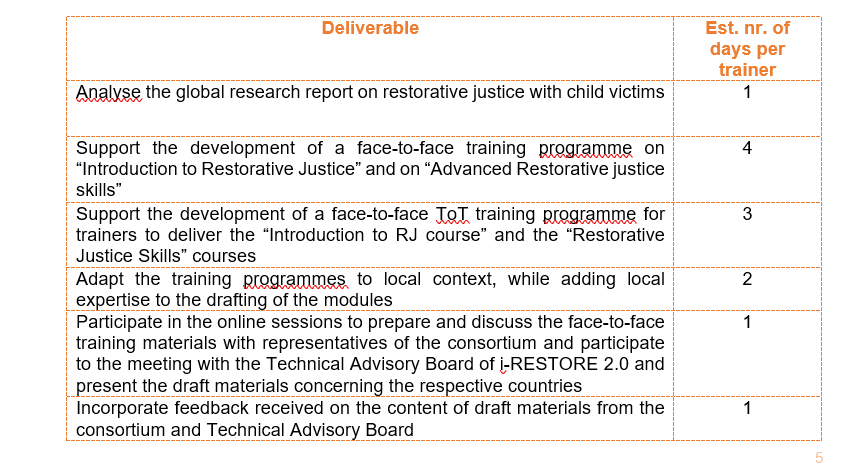

[To send your CV please click here.]
Please include “i-RESTORE 2.0 Restorative Justice Training, your name and surname/name of your company” in the subject line of the application email. Incomplete applications will not be taken into consideration.
Commit to respect Tdh Risk Management Policies including Child Safeguarding Policy, Safety and Security Policy and Anti-Fraud/Corruption Policy, Whistle Blowing Policy.
Commit to respect Tdh Gender & Diversity Policy.
Due to an anticipated high number of applications, Tdh is not in a position to respond to every applicant individually. Please note that only shortlisted candidates will be contacted for the first interview.
You'll be able to quickly and easily find your dream job from your mobile phone!




Try scrolling the rest of the page to see this option in action.